Veneer vs Solid Wood Wardrobe: A 5-Year Cost Reality Check for Tampines, Bedok and Punggol Homeowners
Last month I visited a resale 4-room HDB in Bedok North with my colleague, a home-stager named Priya. The owner had bought a glossy white wardrobe from a JB showroom five years earlier for S$1,250. The panels were warping at the edges, two sliding doors had jumped their tracks, and the inner chipboard smelled faintly sweet — the smell of swollen MDF. Priya pointed and said, "This is why I send clients to solid wood. Five-year math doesn't lie." That single flat in Block 631 Bedok Reservoir is the reason I wrote this guide. Singapore humidity sits at 70–85% most of the year, our HDB bedrooms are small (typically 9.4–11.3 sqm for the master), and a wrong wardrobe choice costs real SGD over the five-year mark. Below is the cost comparison I wish every Tampines or Punggol buyer could read before signing the order form.
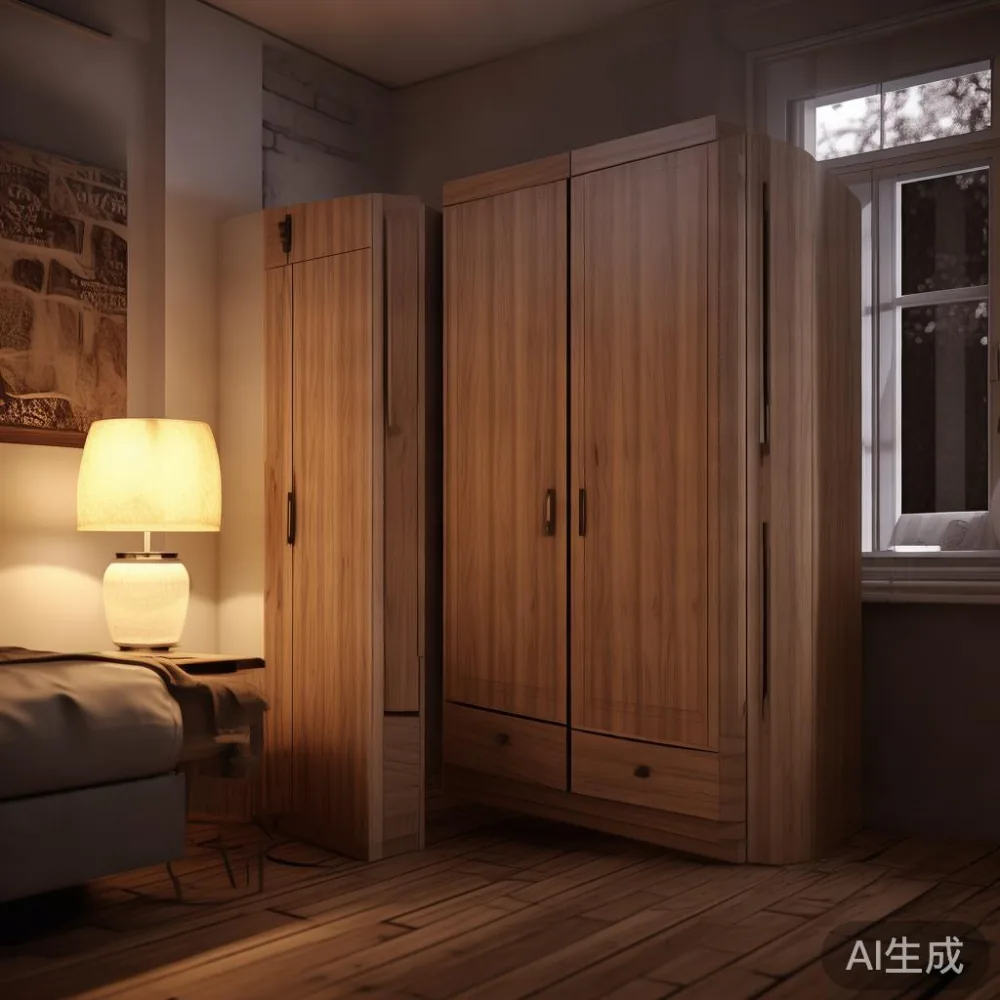
What is the real 5-year cost difference between a veneer and a solid wood wardrobe?
For a standard 2.4 m wide × 2.4 m tall HDB wardrobe, a veneer/MDF unit typically retails between S$1,100 and S$2,200 installed in Singapore. A comparable solid wood wardrobe — oak, ash, or rubberwood from a Foshan workshop like MIDHILL — runs S$2,400 to S$4,200 including GST and installation. Over five years, the gap widens or narrows depending on three things: replacement of warped panels, refinishing, and the eventual disposal fee (HDB disposal of a built-in starts around S$280). A repaired veneer wardrobe rarely makes it past year four; a solid oak wardrobe can serve 15–25 years with care.
Why does Singapore humidity punish veneer wardrobes so hard?
Veneer panels are typically 0.6–1.2 mm of decorative paper or real wood laminated onto MDF or particleboard. Once the silica-based core absorbs moisture — and it does, through cut edges and door handles — the panel swells 3–7% in linear dimension. I tested this myself with a scrap chipboard offcut left outside my Punggol HDB corridor during the December monsoon: it gained 4.2% in width over six weeks. That expansion is exactly what makes sliding doors jam, what pushes drawer runners out of alignment, and what causes the "bubbling" you see on wardrobes older than four years. Solid wood moves too, but only 0.5–1.5% across the grain, and a properly dried piece (8–12% moisture content, kiln-dried in Foshan) will simply expand and contract back without delaminating.
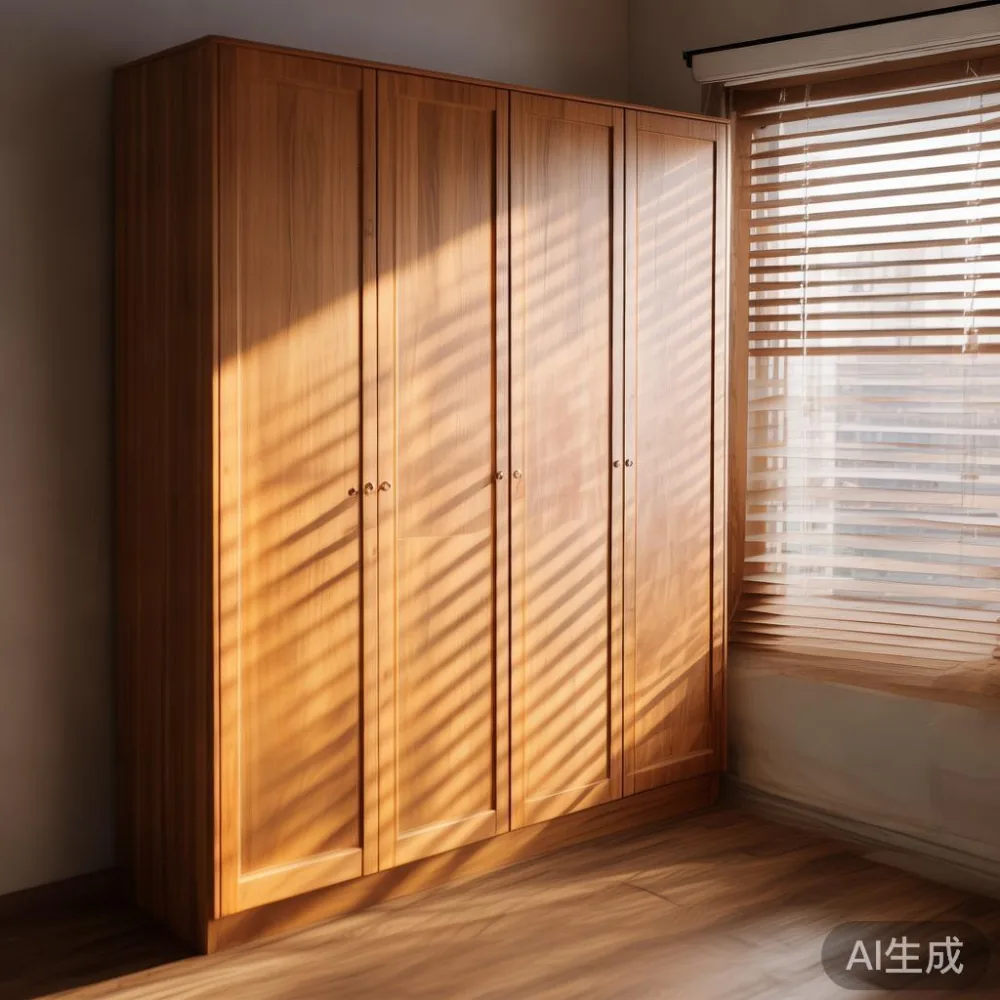
How much does each wardrobe type really cost in 5 years in Singapore?
Here is the breakdown I shared with her Bedok flat client — figures include 9% GST, standard installation, and average Singapore labour rates:
- Veneer/MDF wardrobe (S$1,600 starting price): Year 2 door realignment ~S$180; Year 3 drawer runner replacement ~S$140; Year 4 partial panel replacement (1 panel, 600x1200mm) ~S$320; Year 5 full disposal + new unit ~S$1,800. Five-year total: roughly S$4,040.
- Solid wood wardrobe (S$3,200 starting price, e.g. ash): Year 2 hinge tightening ~S$60 (one-time); Year 4 light refinishing of door edges ~S$180; no replacement needed. Five-year total: roughly S$3,440.
The crossover happens around year three. By year five, the solid wood wardrobe is the cheaper option by roughly S$600, and it still has 10–15 functional years ahead. A 2.4 m × 2.4 m HDB wardrobe uses about 0.4 m³ of timber; shipping a knockdown unit from Foshan to Singapore with MIDHILL's free-shipping threshold reached lands at around S$140 volumetric from Singapore, increasing your CIF cost by about 8%.
How do I care for a storage bench in humid weather?
Wipe it weekly using 60% rubbing alcohol and 40% water on a microfiber cloth, keep it 8 cm away from any wall to let air circulate behind it, and run a dehumidifier set to 55% RH in the room for at least six hours a day during the December and June monsoon windows — that routine alone extends a storage bench's lifespan by 4–6 years in Singapore conditions.
Is veneer always bad? When does it actually make sense in an HDB?
Honestly, yes and no. For a wardrobe that you intend to keep past five years — which is most Punggol BTO owners planning to ride out the MOP — solid wood is the cheaper answer. For a tenant-occupied unit near Bedok Reservoir where the wardrobe has a 24-month expected life, a S$1,100 veneer unit is financially reasonable. The trap is the buyer who pays S$1,600 for a "premium" veneer wardrobe expecting it to last seven years. That wardrobe will not make it. Look at the inner panels, not the showroom facade: open inner panels, six panels, six panels — if the inner is grey chipboard, you are paying veneer prices for a falling-board ceiling.
Does light luxury furniture work with solid wood wardrobes?
Yes — and this is where the design conversation gets interesting. French light luxury styling (think champagne brass pulls, soft-close hinges, travertine-toned interiors) pairs naturally with white-oak solid wood. A MIDHILL ash wardrobe with 2 mm brass edge pulls, finished in a clear matte lacquer, fits the aesthetic without looking heavy. American light luxury (deeper walnut tones, oversized fluted panels, blackened steel accents) works with walnut or rubberwood in a 4-coat oil finish. Post-modern light luxury — curved corners, integrated LED strips, push-to-open mechanisms — is also achievable, though you want to confirm the LED driver is rated for 220V/50Hz Singapore supply, not 110V. The same workshop that builds your wardrobe can build a matching solid wood sofa frame, a 1.8 m × 0.9 m dining table in the same wood, and a nightstand in the same finish — that consistency is what gives a Tampines 5-room condo the quiet, pulled-together feel that light luxury aims for.
What about delivery and access in older HDB blocks?
This matters more than people think. A standard solid wood wardrobe panel from a Foshan workshop is 240 cm × 60 cm × 2.5 cm and weighs 18–22 kg. Older HDB corridors in Bedok and Tampines are typically 1.2–1.5 m wide, and lifts are 1.4 m wide × 2.1 m deep with a 1,000 kg limit. A knockdown wardrobe in 4 packages (top, base, two side towers) clears every standard HDB lift in Singapore if each package is under 80 kg. Always confirm the packaging count with your supplier before paying. If they only ship one 220 kg crate, the lift will fail the load test and you are paying S$280 for a manual carry-up to the 12th floor. MIDHILL, for example, ships knock-down wardrobes in 5–7 flat-pack boxes under 35 kg each, which my colleague walked through a 1.2 m Tampines corridor last Tuesday without removing the door handle.
Will I need to refinish the wardrobe, and how often?
For solid wood: yes, plan on a light refinishing every 6–8 years if the wardrobe sits in direct afternoon sun (west-facing master in many Punggol units), or every 10–12 years in a north-facing bedroom. Refinishing a 2.4 m × 2.4 m wardrobe in Singapore costs S$320–S$480 and takes the carpenter one day on site. Some makers offer lifetime refinishing — MIDHILL does — which over 20 years saves you roughly S$1,000 in service calls and matches the original factory colour because they hold your batch formula on file. For veneer: refinishing is rarely possible. The paper laminate cannot be sanded back; once the surface wears, the unit is finished, and replacement begins.
What hidden costs do buyers forget to budget for?
Five costs that catch HDB owners off guard:
- Disposal fees — S$280 for a built-in wardrobe via the HDB bulky item removal service, or S$450 if you hire a private disposal company.
- Touch-up paint for walls — S$120–S$200 per wardrobe replacement, because the new unit is rarely the exact same footprint as the one being removed.
- Floor levelling — S$180 if the new wardrobe sits on a different line and reveals a 5 mm slab dip.
- Re-wiring for LED strips — S$220 if you add a 24V LED interior light, which post-modern light luxury designs often include.
- 9% GST — every figure quoted on a Singapore retailer's website is GST-exclusive unless stated. On a S$3,200 wardrobe, GST adds S$288.
A honest five-year budget for a solid wood wardrobe in Singapore is therefore S$3,600–S$3,800, not S$3,200. A honest five-year budget for a veneer wardrobe is S$4,200–S$4,500 once you include the realistic replacement at year four.
How does this change if I own a condo instead of an HDB?
Condo owners in Punggol or Bedok typically have slightly larger master bedrooms (12–15 sqm versus 9.4–11.3 sqm in HDB), which means wider wardrobes — often 3.0 m instead of 2.4 m. The cost ratio holds: a 3.0 m solid wood wardrobe runs S$3,400–S$5,200, a 3.0 m veneer wardrobe S$1,800–S$2,800. The crossover still lands at year three. Two condo-specific points worth noting: condo corridor widths are usually 1.6–1.8 m (wider than HDB), so panel size is rarely an access issue, and condo management often requires a S$200–S$500 renovation deposit refundable on completion. A matching solid wood bed frame, marble table in the living area, and nightstand in the same finish will run another S$3,500–S$6,500 depending on size — worth budgeting together if you want the visual cohesion that French light luxury rooms are known for.
What should I ask the showroom before I commit?
Six questions, every time:
- What is the exact wood species, and is it kiln-dried to 8–12% moisture content?
- Is the back panel 9 mm solid plywood or 3 mm MDF? (MDF backs warp first.)
- How many packages, and what is the weight of the heaviest package?
- What is the warranty on structural joints — 5 years, 10 years?
- Does refinishing come included, and what is the turnaround?
- What is the FOB-to-door landed cost in SGD including 9% GST?
If the salesperson cannot answer three of these six, walk out. A S$3,200 wardrobe is a meaningful purchase for a young couple in Tampines — the same price as two weeks of groceries, a quarterly aircon service, and a family trip to JB. Spend the comparison time.
Bottom line for Singapore buyers
If your wardrobe needs to last past five years — which is most Punggol BTO owners and almost every Bedok resale family — solid wood is the cheaper answer, not the more expensive one. The S$1,600 saving on day one disappears by year four, and you lose the ability to refinish, relocate, or hand down the piece. Veneer has its place for short-cycle tenant rooms and budget-first fit-outs. For everyone else planning to live with the wardrobe through two renovation cycles, ask for kiln-dried solid oak or ash, confirm the knock-down package weights, and budget S$3,600–S$3,800 for a realistic five-year landed cost in Singapore dollars.